Back in the day, pitching a tent meant finding a flat patch of grass and calling it home. No rules, no layouts, just freedom. Today, French campsites are a world away from that wild west era. Every square meter is governed by law, designed to balance comfort, safety, and environmental respect. If you're planning a stay in France, especially at a high-end site, understanding pitch size regulations isn't just about space - it's about knowing what kind of holiday experience you're signing up for. Let’s unpack the real dimensions behind the rules.
The legal foundation of French campsite pitch dimensions
In France, campsite pitch sizes aren’t left to chance. They’re shaped by national standards and local planning rules that vary by region and classification. At the most basic level, even a 1-star campsite must offer pitches starting from around 70 to 80 m². These minimums ensure that every guest has enough room for a tent or caravan, a vehicle, and a small private area. But here’s the thing: top-tier sites rarely stick to the bare minimum. Many go far beyond, especially in premium locations where luxury camping privacy is a key selling point.
Five-star establishments, in particular, are expected to provide more spacious layouts, often averaging over 100 m² per pitch. This isn’t just about comfort - it’s part of the official Atout France standards, which evaluate not only size but also landscaping, separation between units, and integration with nature. These sites are designed to feel open, peaceful, and uncluttered, even at full capacity.
Exploring the various options for camping on the French Mediterranean coast allows you to see how top-tier establishments maximize their plot layouts within these legal frameworks. In areas like Fréjus or Saint-Tropez, where pine forests meet the sea, the balance between built infrastructure and natural space becomes even more critical. Local zoning laws - known as PLU (Plan Local d'Urbanisme) - can further restrict density, ensuring that coastal ecosystems aren’t overwhelmed by development.
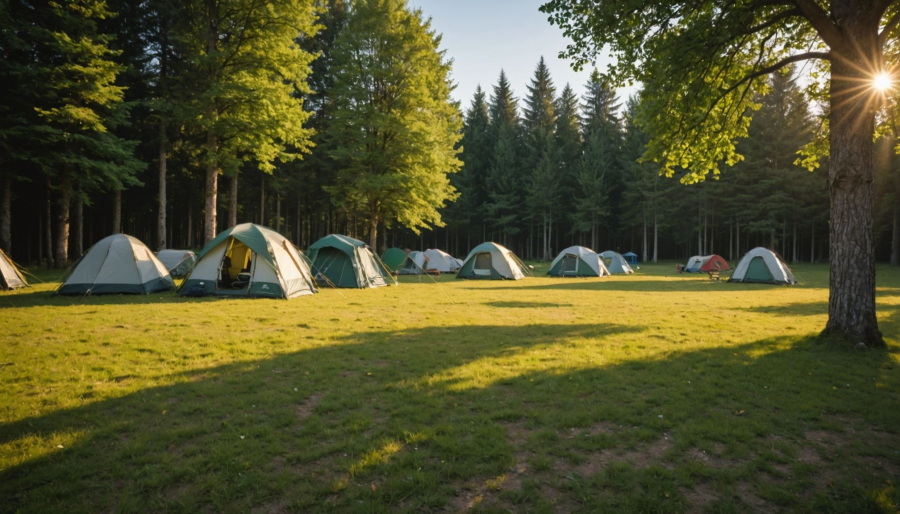
Minimum area requirements for standard pitches
Lower-rated campsites, from 1 to 3 stars, typically offer pitches between 70 and 100 m². While these are functional, they leave less room for large awnings or multiple vehicles. The focus here is on accessibility and basic comfort, not luxury.
The 5-star camping standards for luxury stays
Luxury sites prioritize space and tranquility. Beyond larger pitches, they often include natural screening like hedges or trees, wider access paths, and carefully planned utility hookups to maintain a clean, uncluttered look.
Urban vs. rural zoning constraints
In rural or protected coastal zones, pitch density is often limited by environmental regulations. Nature pitches (emplacements nature) must preserve soil permeability and vegetation, while heavy-duty pitches for caravans require reinforced surfaces and drainage.
Calculating surface area: what counts as pitch space?
It’s easy to assume that “pitch size” means the total area you can use freely. But in reality, not all of that space is equally usable. The declared surface includes the area for your tent or caravan, the vehicle, the surrounding green space, and even the spot where the electricity post is installed. What matters most is the usable flat surface - the part where you can actually set up camp without tripping over roots or slopes.
Green space is a major component. French regulations emphasize integrating pitches into the natural landscape, so many sites use grassy or semi-wooded plots rather than paved surfaces. This helps with drainage and reduces heat buildup, especially in southern regions. However, if you're arriving with a large awning or an XXL caravan, you’ll want to confirm that the level, stable area is sufficient - because a pitch advertised as 100 m² might include a sloped corner or a tree that eats into usable space.
Green space vs. utility area
The ideal pitch balances open greenery with practical access. Utility points like water, electricity, and waste disposal must be within reach but not intrusive. They’re usually placed at the edge of the pitch to preserve the central living area.
Private facilities and their impact on layout
Some high-end sites now offer private sanitary units or outdoor showers, but these are still rare. Most rely on shared facilities, meaning the pitch itself focuses on accommodation and outdoor living. The placement of the electricity post, for example, is regulated to avoid cutting across the main tent zone.
Pitch size requirements by star rating
Comparing 1-star to 3-star plots
Lower-category sites focus on affordability and functionality. A 1-star pitch may start at 70 m², with minimal landscaping and closer proximity to neighbors. These are ideal for budget travelers or short stays, but not for those seeking seclusion.
The spaciousness of 4-star and 5-star luxury
Higher-rated sites reduce density significantly. Instead of maximizing the number of pitches, they prioritize guest experience - wider pathways, natural screening, and larger individual plots. This is where you’ll find the true value of a 5-star classification.
| Star Rating | Minimum Average Pitch Size (m²) | Common Features |
|---|---|---|
| 1-star | 70 | Basic utility hookups, minimal green space, close spacing |
| 2-star | 75-80 | Improved access, some landscaping, shared amenities nearby |
| 3-star | 85-90 | Better separation, more greenery, enhanced services |
| 4-star | 90-100 | Natural screening, spacious layouts, quality facilities |
| 5-star | 100+ | Generous space, premium landscaping, high privacy, eco-design |
Accommodation types and their specific regulations
Not all pitches are created equal - the rules change depending on what you're bringing. Whether it’s a tent, caravan, or mobile home, each has its own set of spatial and structural requirements. This ensures safety, comfort, and long-term sustainability of the site.
Pitches for mobile homes and cottages
For permanent or semi-permanent structures like mobile homes, French law imposes a strict pitch occupancy rate: the building itself should cover no more than 30% of the total pitch area. This includes the footprint of the unit and any fixed wooden terrace attached to it. Removable elements, like folding awnings or freestanding decks, aren’t counted - but anything bolted down usually is. This rule prevents overcrowding and preserves open space for gardens, patios, or future modifications.
Caravan and motorhome accessibility
Maneuverability matters. Sites must provide access roads wide enough for large vehicles - typically at least 4 meters - and turning spaces for motorhomes up to 8 meters long. Pitches designed for caravans often have reinforced gravel or concrete pads to support weight and prevent sinking, especially during rainy seasons.
Nature pitches for traditional tent camping
Known as emplacements nus, these are the purest form of camping. Regulations require that the natural soil remains largely undisturbed, with minimal artificial surfacing. Tents must be pitched on grass or earth, and any temporary structures (like canopies) must be removable. These pitches are often smaller but placed in more scenic, wooded areas, offering a closer connection to nature.
Planning your stay: pitch booking essentials
Booking a pitch in France is more than just picking a spot on a map. You need to consider size, location, and how the layout fits your gear. Many travelers assume that “standard” means universal, but in reality, a pitch that works for a family of four with a small tent might be tight for a group with a motorhome and an awning.
Verifying dimensions before arrival
If you're traveling with oversized equipment, always ask for exact measurements. Some sites provide detailed pitch plans online, showing not just size but also shape - whether it’s square, rectangular, or irregular. This can make a big difference when setting up a large awning or positioning two cars.
Privacy and boundary markers
French campsites use low hedges, wooden fences, or natural plantings to mark pitch boundaries. These are regulated to ensure they provide separation without creating a closed-in feeling. Height is usually limited to 1.2 meters, and materials must be permeable to light and air.
Seasonal variation in availability
During peak season, pitch allocation becomes stricter. Sites may reassign bookings to fit demand, and guests are expected to stay within their designated area. This helps maintain order, safety, and fairness - especially when every square meter counts.
Key takeaways for a compliant camping holiday
The golden rules of pitch etiquette
Respecting your pitch boundaries isn’t just polite - it’s a legal requirement. Overstepping can block access routes or violate fire safety regulations, which mandate clear paths between units.
Density and environmental preservation
Regulations on pitch size and spacing help protect fragile ecosystems, especially in coastal pine forests. By limiting density, France ensures that natural landscapes aren’t sacrificed for tourism revenue.
Safety clearances between installations
There must be at least 4 to 6 meters between two mobile homes or caravans. This gap allows for emergency access, ventilation, and privacy. It’s a small detail that makes a big difference in comfort and safety.
- Always check the minimum pitch size for your accommodation type - don’t assume 80 m² is enough for a large setup
- Remember the 30% occupancy rule for mobile homes: the structure should never dominate the pitch
- Look for sites that exceed legal minimums - extra space means better privacy and comfort
- Verify access conditions if arriving with a large vehicle or extended awning
- Respect seasonal rules - pitch use is often more strictly enforced in high season
Popular questions
Does the 30% occupancy rule include the wooden terrace of a mobile home?
Yes, if the wooden terrace is fixed and attached to the mobile home, it’s included in the 30% footprint calculation. Removable or freestanding decks are generally not counted, but policies can vary by site, so it’s wise to confirm with the management.
How much does a 100m² pitch usually cost in the South of France?
Prices vary by season and location. In high season, a 100m² pitch at a 5-star site in the South of France can range from 40 to 70€ per night. Off-season rates may drop to 25-35€, depending on included services and site reputation.
Are there new ecological regulations affecting pitch shading in 2026?
While no nationwide 2026 rule exists yet, many sites are adopting eco-friendly practices like planting native trees for natural shading. These help reduce heat, protect soil, and enhance guest comfort without artificial structures.
When is the best time to book to secure an XXL corner plot?
For premium plots - especially large corner pitches with extra privacy - it’s best to book 6 to 12 months in advance. High-demand sites on the Mediterranean coast often fill up quickly, particularly for July and August stays.
